

The philosophy behind the work
The Art of Navigating explores what becomes possible when we bring together what we know, what we notice and what we imagine.
The Art of Navigating
A CEO once told me the team that built his company had become the very thing holding it back, and the blank canvas in the workshop showed him exactly why.
Most of us are taught to solve problems with past experience, more information and expert advice. But when the ground itself is moving, the answer isn't the maps we know. It's learning to read the terrain as it unfolds and trusting what you find there.
The Art of Navigating is a creative practice that builds calm, clarity and focus when the terrain keeps shifting.
The three things usually tangled together
Most situations are shaped by more than one thing: an old map, an inherited story and the terrain itself. Seeing them separately often opens up a wider view, not just a way past what's blocking you, but things you hadn't consider at all.

MAPS
We rely on maps
The models and mental structures we use to make sense of the world are useful until they aren't. The moment a map starts to matter more than the terrain, it begins to mislead, because every map is a perspective and story about the world, not the world itself.

STORIES
The narratives we inherit
Beneath the maps sit the stories: the assumptions we carry about ourselves, other people and the world, mostly inherited and rarely examined. They shape what we see before we've even looked, which is why the first real step in finding a way through is noticing the stories already guiding us.

THE TERRAIN
The reality we're faced with
Terrain is uncertain, shifting and resistant to simple categorisation. Learning to read it, rather than imposing a map onto it, is the central challenge. It always holds more information than any map can, and the real question is whether we're open enough to see it.
Where creativity becomes navigation
Creativity is how you actually work with all three. Through painting, movement, music or writing, a map, a story or the terrain itself can suddenly look different than it did a moment ago. This is where the analytical mind and the intuitive mind meet.
Practise this for long enough and something shifts: you stay steadier in what's actually happening, you trust what you notice before you can explain it and you build judgement from real experience rather than repetition.

The Inner Compass is not a tool you apply. It is a quality of attention you develop.

THE FOUNDATIONS
Older and newer ways of finding a way through
Navigating well takes the whole of you: the analytical mind alongside the intuitive one, old stories alongside new ones, structure alongside freedom. The more capable machines become at making decisions for us, the more it matters that we keep those parts of ourselves alive.
This draws on cognitive science, Jungian psychology, Taoist philosophy and indigenous navigation traditions, spanning thousands of years.
The aim isn't a new map to follow. It's loosening the grip any map has on you, this one too, until you're seeing for yourself.

Cognitive science
How the mind stays adaptive under uncertainty rather than defaulting to what worked last time. In the workshop, you feel that directly, moving between structure and freeform, logic and intuition, until the two stop competing.

Taoist philosophy
Acting in accordance with what is, not what we wish were true. In practice, that's following what emerges on the canvas rather than forcing it toward an outcome.

Jungian psychology
How the unconscious is a source of intelligence rather than noise. In the workshop, the canvas holds the whole of you. As the layers build, old stories and unexpected patterns surface. and it becomes closer to a mirror than a picture.
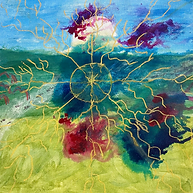
Nature based traditions
Older ways of reading terrain that Western culture has largely set aside. In the workshop, that comes through storytelling in the guided meditation, where nature's imagery becomes wisdom people carry to the canvas.
In the workshop you will experience navigating yourself, with gentle guidance rather than a theory to follow. It's less something you learn once than a state of mind you keep returning to.
Where the ground changes

For leaders and teams
This is where a team learns to navigate new ways of working together, without losing each other along the way.
Everyone faces the same blank canvas, and that shared unknown reveals what rank usually hides: some take longer to make the first bold mark, and the ones who move fastest often learn that bold doesn't automatically make something beautiful.
Watching three colours turn into dozens of shades tends to be the moment a team stops defending its own view and starts noticing what happens when every perspective is let in. Teams often say the way they listen to each other doesn't fully go back to how it was.
For individuals
This is where you find your voice, write new stories and become the artist of your life.
One participant, a professional musician, had been stuck writing his own album. On canvas, he could see his voice and melody as colour and line in a way sound never let him, and it showed him exactly where the block had been.
Away from his own instrument, he let that voice emerge freely, without judgement, before giving it any structure. The inner critic demanding perfection had nothing left to hold onto, and he left with a first draft of the album that had eluded him.

A DIFFERENT KIND OF DEVELOPMENT
Not more thinking, but a different way of seeing
Most leadership development works on the surface: new frameworks, new skills, new processes. This works underneath that, building the quality of thinking that determines how well everything else works.
It isn't a quick fix or a toolkit. It just asks for curiosity and a willingness to set aside what you already know. Bring that, and something will begin to shift.

