.png)


The Creative Muscle
How to find your way back to the capacity you already carry
Six practices for rebuilding your creative capacity, for the moments when thinking harder stops being enough.

BEFORE YOU BEGIN
Creativity is not a talent.
It is a muscle you have stopped using.
When the map runs out and the usual tools stop working, something genuinely new is needed. Most of us reach for more thinking, more planning, more analysis and just pushing through.
But the kind of clarity that arrives at a real crossroads rarely comes from thinking harder. It comes from a different capacity entirely. One that every human being carries. One that most of us quietly abandoned somewhere between childhood and competence.
Creativity is not reserved for artists. It is the capacity to find new ways when the old ones run out. And it grows stronger every time you use it.
These six practices are not exercises in self-expression. They are ways of rebuilding a navigational tool, one small act of attention at a time. None require talent, equipment, or time you don't have. They require only a willingness to approach things differently and notice what emerges when you do.
1.
Give Yourself Space
Stillness is where new things surface.

-
Empty your mind of thoughts, deep breaths and relax your body
-
Simply sit in silence for ten minutes
-
Take a mindful walk in nature
-
Listen to music without doing anything else
What wants to surface when you stop filling the space?
2.
Play Without Purpose
Where there is no right or wrong, the creative muscle remembers itself.

-
Paint or doodle freely
-
Sing, hum, or move without a purpose
-
Experiment with sound and rhythm
-
Write for five minutes without stopping or editing
-
Let it be messy. Let it surprise you
Play without judgement and see what comes alive.
3.
Open Your Senses
Attention is the beginning of new seeing.

-
Take a sensory walk in nature and feel the rain, wind or sun on your skin
-
Smell the earth, taste a berry and listen without naming
-
Look at something familiar for longer than feels comfortable
-
Notice what you usually overlook
Slow down and experience the world with innocence.
4.
Let Nature Speak
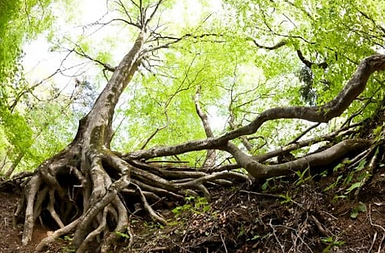
Nature navigates uncertainty without a plan. It reads the terrain and responds.
-
A tree's roots and branches — stability and reach
-
The rhythm of waves — persistence without force
-
A river finding its path — not pushing but flowing
-
Ask: what is this showing me about my life right now?
Nature is full of wisdom, if you choose to see it.
5.
Shift Your Perspective
The view changes when you change where you are standing.

-
Take a new route and notice what you have never seen
-
Use your non-dominant hand for something ordinary
-
Rearrange your workspace or sit somewhere unfamiliar
-
Talk to someone whose worldview is different from yours
Different lenses reveal different possibilities.
6.
Make Unexpected Connections
The creative mind sees what the logical mind organises away.

-
Spot shapes in clouds, faces in bark, hearts in stones
-
Notice frozen patterns in puddles, light through leaves
-
Pick two unrelated things. What do they share?
-
Keep a notebook for images and phrases that catch you unexpectedly
Train Your Eye to See Beyond the Obvious.
_edited.png)
_edited.png)
"You do not need to become creative. You already are."
The map has run out. That is not the end of the journey. It is where the creative capacity you already carry begins to matter most.