.png)


A SIX PART ONLINE COURSE
When the Map runs out
A creative practice for finding your own way through change
You haven't lost your way. The map has simply run out and no amount of thinking harder will draw the next part of the road.
This course offers something different. Through painting, guided reflection, and a practice rooted in Jungian psychology, Eastern philosophy and the wisdom of the natural world, you will begin to find your own compass again.

WHO IS THIS FOR
You are good at thinking. You have thought about this a great deal, and still something stays stuck.
Perhaps a role or relationship you have outgrown but cannot yet leave behind. A life that looks right from the outside and feels hollow from within. A sense that the person you were before this moment no longer quite applies, and the person you are becoming hasn't arrived yet.
Maybe you left something behind years ago; a creative self or a way of being that got crowded out by achievement and obligation. You are feeling its absence without knowing how to return.
You are not falling apart. You are between maps and that is exactly the right place to begin.
This course is for people who are capable but lost, not because they lack answers, but because the questions have changed and the old tools are no longer enough.
You do not need to think of yourself as creative or painted before. What you need is a willingness to try something your analytical mind cannot fully control and to notice what surfaces when you do.
THE COURSE
Six Modules. One Journey
Each module follows the same arc. You begin with a short reflection to arrive fully in the session. A teaching opens the theme drawing on psychology, philosophy and the intelligence of the natural world. A guided meditation takes you beneath the thinking mind. Then you paint unhurried and without judgment or needing it to look like anything. Each session closes with written prompts to draw out what the painting has surfaced.
You travel through all six stages while painting. The canvas becomes the place where something that couldn't be thought begins, instead, to be seen.
1.
When the Map Stops Working
The edge of what you know is where everything begins
.png)
We begin where you already are, at the edge of what you know. In this first session you will paint without a plan, without a goal, without needing it to look like anything. You will stay with not-knowing longer than is comfortable. Something in that staying is the beginning of everything that follows.
What wants to surface when you stop filling the space?
2.
The Narratives We Live In
See the stories you navigate by — and choose which ones to keep
.png)
Before we can navigate, we need to see what we are actually navigating by. This session surfaces the stories you carry; about who you are, what is possible, what you deserve. Things that you have long mistaken for fact. As you paint, some of these stories will begin to appear on the canvas. You do not have to do anything with them yet. Seeing them is enough.
Which of your stories are true and which have simply never been questioned?
3.
The Maps We Rely On
The framework that no longer fits is showing you something important
_edited.jpg)
We trust systems likr frameworks, strategies and structures to make sense of the world. This session examines what happens when those structures stop fitting the territory. Through the painting you will begin to map your current situation honestly, not as it should be, but as it actually is. There is something clarifying and quietly liberating about putting that on paper.
What would you see if you looked at your situation as it actually is, not as it should be?
4.
Meeting Life As It Unfolds
Stop projecting. Start attending. The terrain has more to say than you think.

This session is about paying attention, not thinking about your situation, but attending to what is actually present. In the natural world, nothing navigates by forcing a direction. It reads the terrain and responds. You will do the same. The painting becomes a record of what you notice when you stop projecting and begin, instead, to look.
What does this moment actually contain when you stop expecting it to be different?
5.
The Compass Was Always There
Clarity doesn't arrive on demand — but in the right conditions, it arrives
.png)
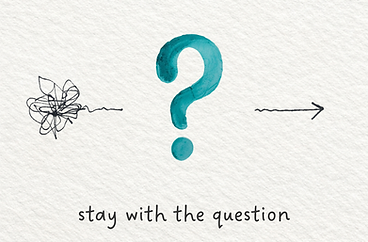
The deepest session. This is where your actual question, the one underneath the one you arrived with, is held in the practice. You will paint without guidance, with sound, with space. Clarity does not arrive on demand. But in the right conditions, and with the right quality of attention, it arrives. Most people find that it does.
The compass was always there. This is where you find it.
6.
From Reaction To Creation
You leave not with answers given to you, but with trust in your own capacity to find them
.png)
In this final session you will create a painting to keep, a visual compass for the wall. The whole journey is integrated here: the stories examined, the maps questioned, the terrain met with open eyes. You leave not with answers delivered to you, but with a renewed trust in your own capacity to find them. That is what it means to become the artist of your life.
This is what it means to become the artist of your life.
WHAT PEOPLE SAY
"It sparked conversations across the whole firm. I highly recommend this inspiring workshop — exploring the balance of structure and imagination."
- Karen, CEO at KJS Solicitors
"This was a game changer for me. It gave me incredible insights into the dynamics and wellbeing of my team."
"Beautifully organised, creatively inspiring and a fantastic experience for personal growth and team bonding."
- Jayson, Founder at 8Ray Group
- Gemma, Head of Councelling at TAB
WHAT IS INCLUDED
- 6 teaching videos
- 6 painting guidance videos
- A simple materials guide
- 6 guided meditation audios with soundbowl
- Reflection prompts for each module
- Lifetime access working at your pace

- Complimentary 30-minute session with me once course is completed
ABOUT MARIE
I have spent my life between worlds that rarely speak to each other.
I began in finance — PwC, banking, the world that rewards precision, speed, and measurable outcomes. Then I founded a creative business, built it over a decade, and sold it. After that I spent fifteen years coaching and facilitating — working with leaders, teams, and individuals navigating the kind of change that doesn't come with a roadmap.
None of those worlds fully overlap. The gap between them — between logic and intuition, between structure and imagination — is where I have always lived. That is where this work comes from.
My own map has run out more than once. I know what it feels like to be capable and lost simultaneously. I know the moment when thinking harder stops being the answer.
What I found on the other side of those crossings drew from many directions at once — Jungian psychology and Eastern philosophy, the wisdom traditions of indigenous cultures, the intelligence of the natural world and the particular kind of knowing that only comes from creating something. These are not separate influences. They are different languages for the same thing. That we navigate best not by forcing a direction, but by learning to read the terrain we are actually standing in.
That synthesis became the Inner Compass Method — the framework I use with organisations, and the practice at the heart of this course.

You do not need to be an artist to be here.
You only need to be willing to begin.
QUESTIONS
Do I need any painting experience?
None at all. This practice is designed specifically for people who do not think of themselves as creative. The painting is a method, not a performance. What you make does not need to be beautiful. It needs to be honest.
What materials do I need?
Simple, inexpensive materials available from any art shop. A full list is provided when you enrol. Nothing specialist, nothing precious. The practice is about the process, not the equipment.
How long does each module take?
Between 45 minutes and 90 minutes, depending on how long you choose to paint. You set the pace. There is no rush, no deadline, and no wrong way through.
Is this therapy?
No. This is a creative and reflective practice. It draws on Jungian psychology and Eastern philosophy as frameworks for understanding, not as clinical tools. If you are in acute distress, please seek appropriate professional support alongside this work.
When can I start?
Immediately. The course is self-paced and available the moment you enrol. You can begin the first module today, or give yourself a week to gather materials and settle in. It is yours to come back to whenever you are ready.
_edited.png)
_edited.png)
_edited_edited.jpg)
.png)
_edited_edited.jpg)
.png)
.png)
.png)